Review
Renogy 100 Watt Monocrystalline Solar Panel Review: The Panel-Only Starting Point
How this review was made: we have not hands-on tested this unit. This review is built from the manufacturer's stated specs, the manuals, and owner reporting, all linked below. Every figure is brand-stated or sourced; nothing here is a bench test.
This is a spec-and-source review, not a hands-on test. The facts below come from Renogy's own product pages and datasheet for the 100W monocrystalline rigid panel (RNG-100D family), checked on November 15, 2026.
One sourcing note, stated plainly because it affects two rows of the table: Renogy's regional listings do not agree on every detail of this panel family. The EU listing states 32 cells and a 5-year material and workmanship warranty; the US G2 listing and datasheet state 36 cells and a 10-year material warranty. The electrical ratings below agree across the brand's pages; where they do not, the table says so instead of picking a winner quietly.
The short verdict
Suits: It suits a builder starting or expanding a 12V system one panel at a time: a standard 100W rigid panel with published electrical specs, MC4 connectors, and a 25-year power output warranty, at the lowest price per panel in this catalog.
Skip it if: Skip it if you want power out of the box. Renogy's own package list is the panel alone: no charge controller, no battery, no mounts. A starter kit, or the controller and battery lines elsewhere in the power catalog, has to join it before anything charges.
Specifications, as the brand states them
A single rigid 100W panel is the atom of every solar build in this catalog, and Renogy's version is the default atom: standard dimensions, standard MC4 connections, a complete published electrical spec, and distribution wide enough that its price is checked against more stores than any other panel here. Nothing about the spec sheet is exotic, which is precisely the point. Systems get built from parts whose numbers are known.
The discipline this review has to keep is about the box, not the panel. The box holds a panel. Everything that turns a panel into power, the controller, the battery, the mounts, the cable runs, lives elsewhere in the power catalog, and the sizing guide exists to do that math before money moves. Bought as the first or the fourth panel of a system whose other parts are already chosen, this is the safest watt in the catalog. Bought as a complete solution, it will sit in its box being correct and useless, and the spec sheet never claimed otherwise.
In a stockpile plan, this panel's role is charging the batteries that run the loads the readiness quiz asks about first: lights, radios, phones, and medical devices. Renogy's own ecosystem gives it a straight path, since the Rover charge controllers and the AGM and lithium batteries elsewhere in this catalog are specified to work with panels like this one, and the solar sizing guide walks the watt-hour math panel by panel before any money moves. Start with the load list, not the panel count, and a 100W unit stops being a guess and becomes a line item.
Strengths, from the sourced facts
- The electrical spec is complete and standard: 100 W at STC with Voc, Isc, Vmp, and Imp all published, so the panel sizes into any 12V system math without guessing.
- Renogy states the panel withstands 2400Pa wind and 5400Pa snow loads, with a corrosion-resistant aluminum frame and tempered glass: the durability claims are printed, not implied.
- Bypass diodes minimize the power drop from shade, per the brand, which matters for the partial-shade rooftops and yards most home systems actually get.
- The 25-year power output warranty guarantees at least 80% output at year 25 on the brand's own terms, the longest horizon of any product in the power catalog.
Weaknesses, from the sourced facts
- The package is the panel only, per Renogy's own package list: no charge controller, battery, cables beyond the 2 ft leads, or mounting hardware. Z-brackets and other mounts are separate product lines.
- One 100W panel is a starter or expansion unit. On its own numbers it cannot run a household; it charges a battery slowly, which is the honest job description.
- The junction box is IP65, which Renogy describes as protection against particles and low-pressure water jets, not submersion. Mounting still has to respect weather like any electrical fitting.
- Renogy's own regional pages disagree on the cell count (32 vs 36) and the material and workmanship warranty (5 vs 10 years) for this panel family, so buyers outside the US should confirm which listing's terms apply to their order.
Price history
Lowest recorded price: $90.99 on November 27, 2026 · tracked since November 11, 2026.
Where to buy it
Renogy
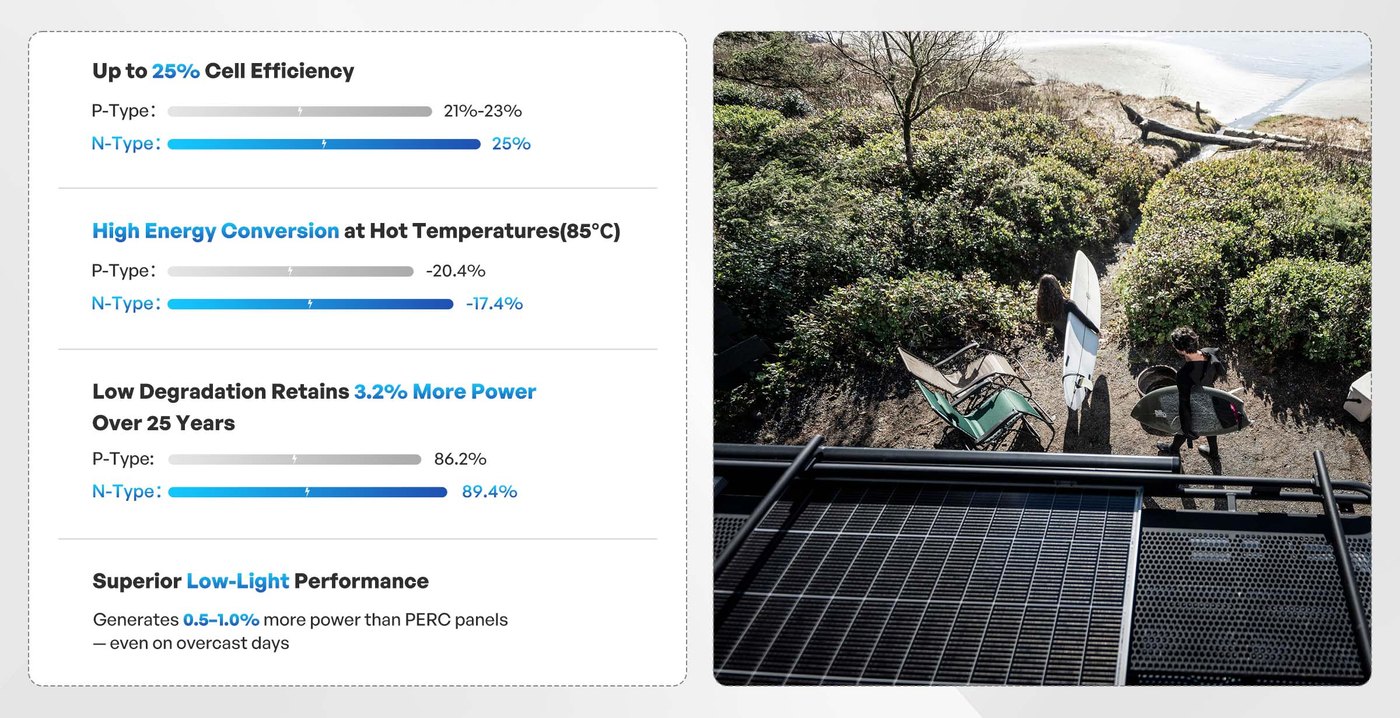
The expansion unit: one rigid 100W N-Type panel, 25% cell efficiency, with a brand-stated 10-year warranty and 25-year output guarantee. For growing an existing array or replacing a casualty.
Back to the full catalog: Power catalog · All guides and reviews
Sources
Specs and prices last verified November 11, 2026.
Reader comments
No comments yet. Yours could be the first; every comment is read by a person before it appears here.